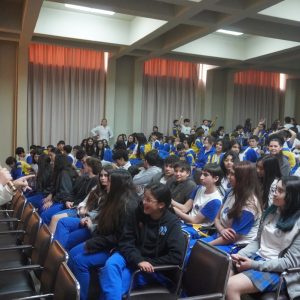
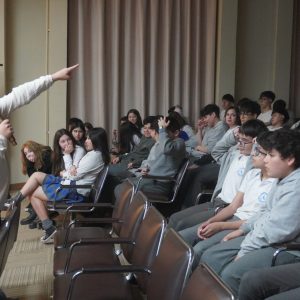
Students from 3rd grade Senior Area took part in an interdisciplinary project entitled “Scientific Symposium: Research, Analysis, and Academic Communication in Biology”, a learning experience that brought together scientific thinking, academic research, and communication in English.
The project was developed through the articulation between Biology, guided by Ms. Iowanna Maltés, and the English Immersion Plan, led by Mr. Marcos Riveros. This collaboration invited students to approach scientific knowledge from a more authentic academic perspective, where English became a tool for accessing specialised information, understanding current research, and communicating ideas with clarity and precision.
Unlike other classroom activities, this project was designed to recreate part of the experience of real scientific dissemination. Students did not only study biological content; they also went through the process of searching for scientific articles, selecting reliable sources, analysing information, writing academic summaries, applying international citation standards, designing scientific posters, and presenting their work in a simulated symposium.
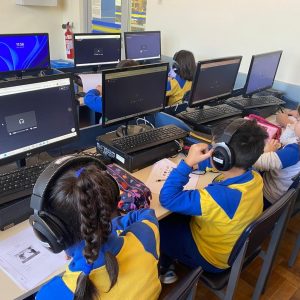
During the first stage, students explored Google Scholar to find recent scientific articles published within the last five years. These articles had to be open access and connected to scientific journals, allowing students to develop important criteria for selecting valid and relevant academic sources. This step introduced them to the way scientific knowledge is built, shared, and evaluated in real academic contexts.
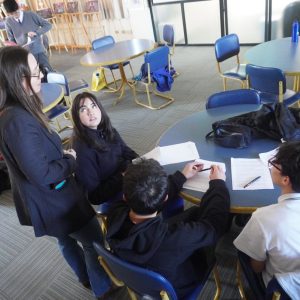
After selecting their articles, students moved into the analysis and synthesis stage. Working collaboratively, they read and organised the information from their chosen texts, identifying key elements such as objectives, methodology, results, and conclusions. This process helped them strengthen their reading comprehension, critical thinking, and ability to transform complex scientific information into clear academic writing.
Another important part of the project was the use of APA 7 citation standards. Through this stage, students learnt that academic work is not only about presenting information, but also about recognising sources responsibly and following formal conventions used in research and higher education. This gave the project a strong connection with the skills students will need in future academic and professional contexts.
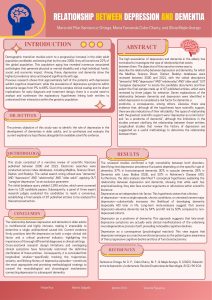
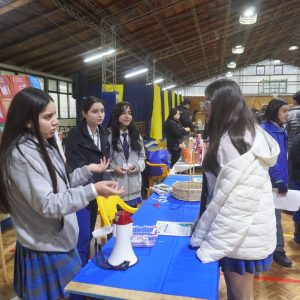
The final stage of the project focused on scientific communication. Each group designed a scientific poster with the main sections commonly used in academic presentations, including introduction, methodology, results, conclusions, and references. Students then presented their work in a simulated internal symposium, following the structure and expectations of an academic conference.
This type of experience is especially meaningful because it allows students to connect Biology with the use of English in a realistic and purposeful way. In this context, English is not approached only as a school subject, but as a language of science, research, and international communication. At the same time, students develop transversal skills such as teamwork, time management, digital organisation, oral presentation, academic writing, and scientific argumentation.
Below, we share two selected posters created by students as part of this interdisciplinary learning experience.