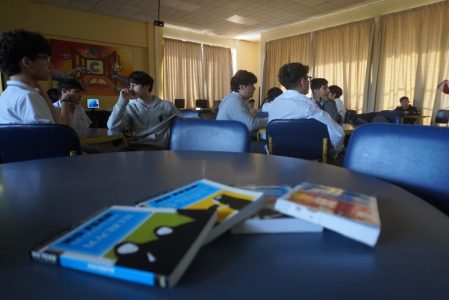
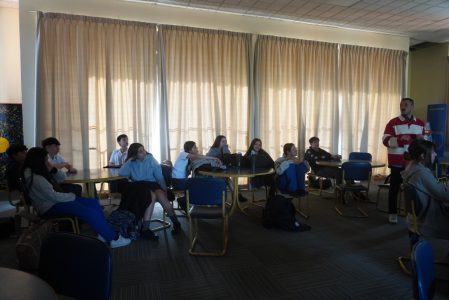
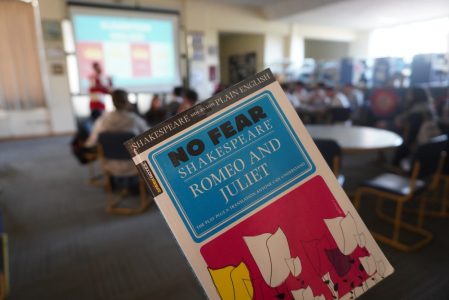
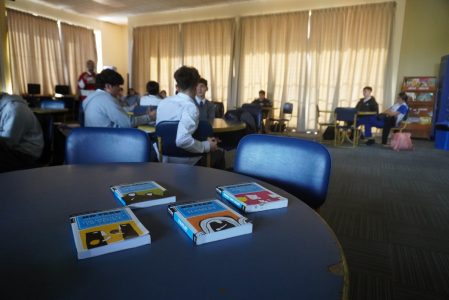
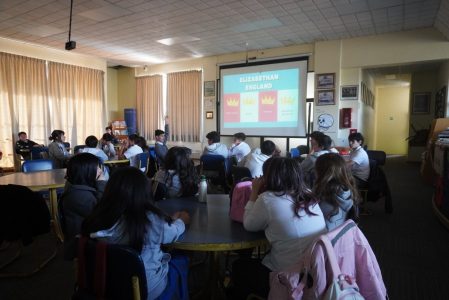
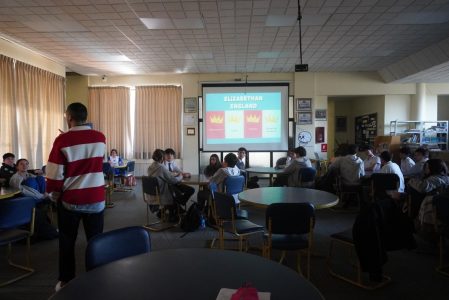
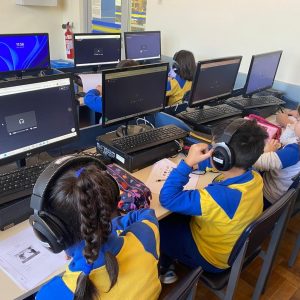
Continuing the series of experiences developed with 1st grade classes, students from 1st grade A, Senior Area, participated in a session connected to their reading of Romeo and Juliet, exploring the world behind William Shakespeare’s work and the cultural context of the Elizabethan era.
The activity took place during the Spanish Language class, guided by Ms. Elizabeth Urzua, and was developed in articulation with the English Immersion Plan, led by Mr. Marcos Riveros. This collaboration allowed students to approach the play from a broader perspective, connecting literature, history, language, and culture as part of their reading process.
During the session, students explored different elements that help explain why Shakespeare’s works continue to be relevant today. One of the most engaging moments was the analysis of Shakespearean language, where students discovered how creative, expressive, and dramatic communication could be in his plays. Through examples of insults, phrases, and dramatic expressions, they reflected on the richness of language and its connection with character, conflict, and emotion.
The class also focused on the influence of Shakespeare on the English language, helping students recognise that many words and expressions commonly used today have their roots in his works. This allowed them to understand literature not only as a written text, but also as a living part of language and culture.
Another important part of the experience was the exploration of the Elizabethan era, including the social, cultural, and historical context in which Shakespeare wrote. This helped students connect the conflicts and themes present in Romeo and Juliet with the world that surrounded the play, giving them tools to understand the text beyond the plot.
To bring the activity closer to their own context, students also worked on adapting selected excerpts into modern Spanish. This exercise encouraged them to interpret the meaning of the original lines and transform them into language that felt more familiar, reinforcing the idea that classic literature can still speak to new generations when it is approached creatively.
Although the session was developed within the Spanish Language subject, the English Immersion Plan contributed by opening a bridge between the reading process and the cultural universe of an English-language literary work. Through this articulation, students were able to connect with Shakespeare from a wider perspective, where language, literature, history, and culture come together as part of a meaningful learning experience.