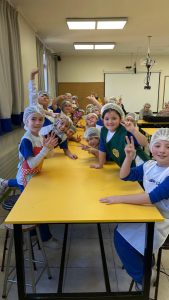
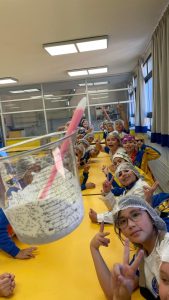
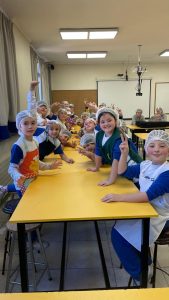
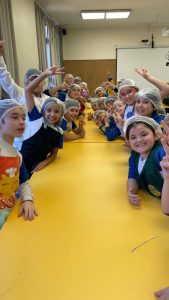
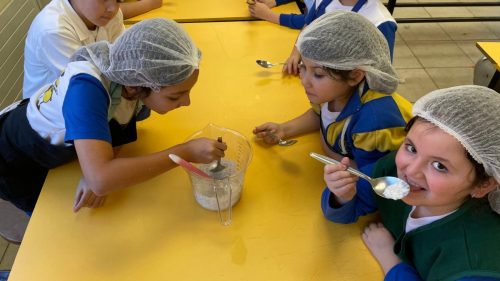
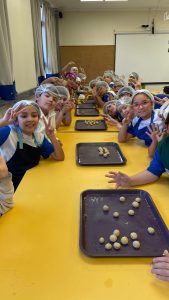
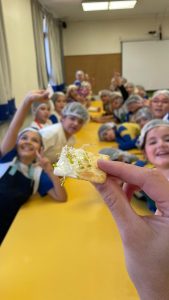
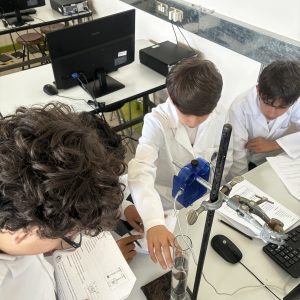
Students from 3rd grade A took part in the second stage of their Life Sciences project through a practical healthy food workshop, developed during the Elementary Natural Science subject, guided by Ms. Kerstin Litschi Renner, in articulation with the English Immersion Plan led by Mr. Marcos Riveros.
This activity continued the work carried out at the beginning of May, when students observed the germination of chia seeds in the school greenhouse. After seeing how seeds begin to grow, this new experience allowed them to take that learning into a more concrete context by exploring how plants and seeds can also be part of our food.
Throughout the workshop, students worked with different ingredients connected to plant origin, including oats, apples, chia seeds, chia sprouts, and yoghurt. The use of the chia sprouts was especially meaningful, as these had been previously grown by the students themselves. In this way, the activity helped them understand that what they observe in Science can also be connected to wellbeing, healthy habits, and everyday life.
The whole session was conducted in English, giving students the opportunity to follow instructions, identify ingredients, ask and answer simple questions, and participate actively while using the language in a real context. English became part of the experience naturally, supporting communication during each step of the workshop.
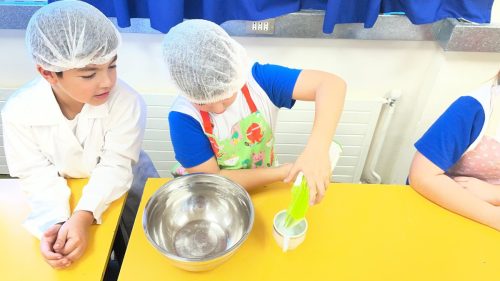
Students prepared and tasted different healthy options, including crackers with yoghurt and chia sprouts, chia seeds with yoghurt, and oat and apple cookies. As part of the experience, students prepared oat and apple cookies using 1 large grated apple, 1 ½ cups of instant oats, 1 egg, ¼ cup of brown sugar, and ½ teaspoon of baking powder; cinnamon powder can also be included for extra flavour. The ingredients are mixed together, shaped into small cookies, and baked until they are firm and lightly golden, making this a simple recipe that families can also try at home.
Before preparing the food, students reviewed important hygiene habits such as washing their hands, keeping the workspace clean, and using materials responsibly. These moments helped reinforce that cooking and learning also require care, organisation, and respect for shared spaces.
This experience allowed students to recognise that plants and seeds are valuable sources of food for living beings. It also helped them understand that seeds can be consumed in different forms, whether germinated or not, and that healthy eating can be explored through observation, curiosity, and practical learning.
Through activities like this, the English Immersion Plan continues to create meaningful spaces where English connects with other subjects and becomes part of real classroom experiences. For 3rd grade A, this stage of the project transformed learning into something they could observe, prepare, taste, and share.