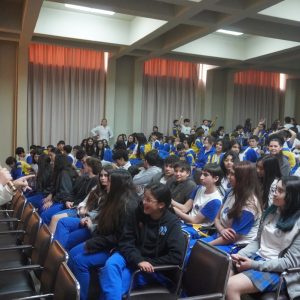
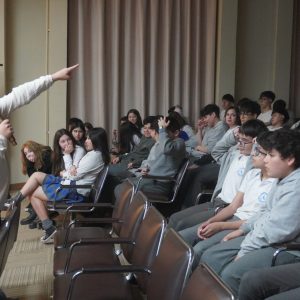
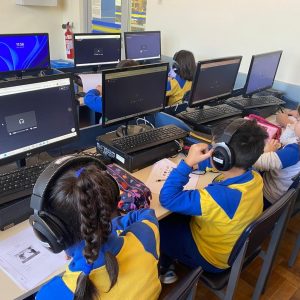
As part of the interdisciplinary project “80 Years Since World War II: Art in Times of War,” the ICT student team, Valentina Oyanadel, Catalina Oyanadel, and Rocío Oyarzúa, continued their interview series with the teachers leading each dimension of the initiative. Designed, recorded, and transcribed by the students, these interviews document the reflections behind the project’s artistic, historical, and ethical components.
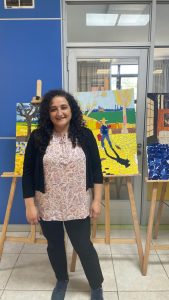
In this interview, Ms. Sonia González, Visual Arts teacher for 8th grade, described her experience as both “entertaining and challenging,” emphasizing how meaningful it was to connect different subjects through a single theme. She explained that working interdisciplinarily allowed students to see Visual Arts from a new angle, encouraging them to integrate historical context, aesthetic analysis, and personal interpretation in their creative process.
When asked about the impact of teacher collaboration, Ms. González highlighted the importance of modeling teamwork for students. She noted that when teachers from different disciplines, arts, history, English, geography, aesthetics, and technology, work together, students witness firsthand how collaboration can expand learning opportunities and promote a culture of peace and mutual support. “It shows them,” she said, “that working hand-in-hand allows us to create something much more powerful than what we could achieve alone.”
One of the key moments in the project, she explained, occurred when students began the re-creation of stolen artworks. As they explored each piece and engaged with its visual elements, the artworks started to “belong” to the students, transforming from historical artifacts into personal creative expressions. Through this process, learners interpreted each masterpiece through their own vision, making the project truly their own.
Ms. González also spoke about the importance of studying World War II through art, literature, and propaganda. She emphasized that Visual Arts always requires a contextual framework, and working from historical, aesthetic, or conceptual perspectives helps students develop not only visual analysis skills but also critical thinking. By understanding the context of the war, students were able to go beyond technique and investigate the deeper meanings embedded in each artwork.
Regarding Artificial Intelligence, she reflected on its opportunities and risks. While AI can support research and idea development, she noted that it can also present biased or inaccurate information. For this reason, she emphasized the importance of verifying results, maintaining human judgment, and using AI ethically, particularly in relation to authorship and the accuracy of historical information. “These tools must support students’ work,” she said, “not replace it.”
Finally, she highlighted several final products that demonstrated student growth. In Visual Arts, students conducted aesthetic and critical analyses of the stolen artworks, examining visual attributes, historical context, and the impact of Nazi looting. They created two layers of interpretation: one before learning the full historical story, and another after investigating the context. This comparison revealed how understanding history can transform artistic perception and deepen appreciation for the work.
This interview forms part of the broader narrative of “80 Years Since World War II: Art in Times of War,” showcasing the reflections behind the project’s artistic dimension and the transformative experiences lived by the students. More interviews will continue to be published as the series unfolds.