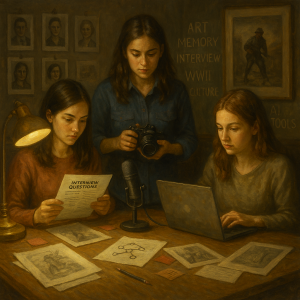
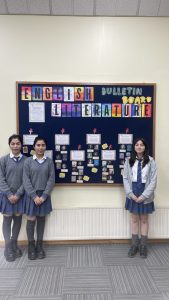
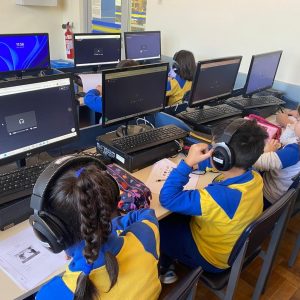
As part of the interdisciplinary project “80 Years Since World War II: Art in Times of War,” students Valentina Oyanadel, Catalina Oyanadel, and Rocío Oyarzúa, members of the ICT extracurricular class, carried out a series of interviews that combined audiovisual production, bilingual work, and critical thinking. Their role was central to documenting the project and giving visibility to the voices behind ABP COEMCO 2025.
Although the interviews were conducted in Spanish, the entire creative and technical workflow took place in English, allowing the students to use the language authentically as they planned, organized, and produced the written material. English became a working tool, not only for editing and writing, but also for research, digital processing, and decision-making.
The process began with students generating potential interview questions with the support of Artificial Intelligence, then evaluating and refining them based on clarity, relevance, and depth. This selection process required them to combine technology with human judgment, exercising analysis, comparison, and editorial decision-making. The result was a set of interviews that reflect genuine curiosity and a strong commitment to understanding the project from multiple disciplinary perspectives.
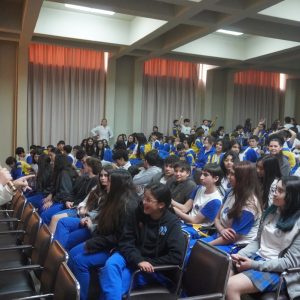
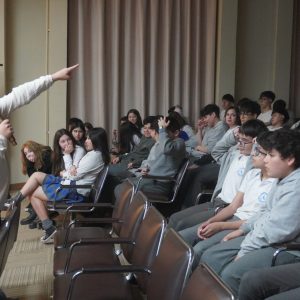
With their scripts finalized, the students conducted and recorded interviews with the four teachers leading the project: Ms. María Patricia Jerez, Mr. Víctor Saavedra, Ms. Sonia González, and Mr. Luis González. These conversations explored interdisciplinary coordination, ethical questions related to wartime art, the role of English in expanding cultural perspectives, and the learning processes that emerged throughout this initiative.
After the recordings, the ICT team completed the transcription stage, using AI to support accuracy, clarity, and speed. Critical thinking remained essential, as students compared automated transcriptions with the original audio, corrected errors, and ensured that each teacher’s voice and ideas were represented faithfully.
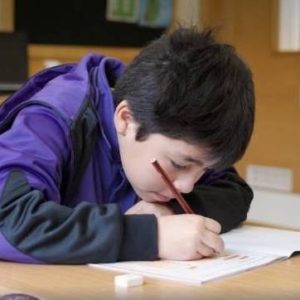
The final step involved transforming each interview into a polished article written in English. AI tools were again used ethically to support drafting, structure, and cohesion, while the students maintained full authorship of the interpretations and narrative shaping. This stage reinforced their academic writing skills, digital literacy, and bilingual communication.
The result is a collection of articles that highlight teacher perspectives, demonstrate student agency, and showcase the intersection of art, history, language, and technology within this project.