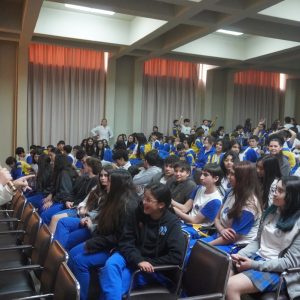
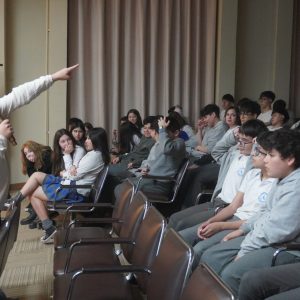
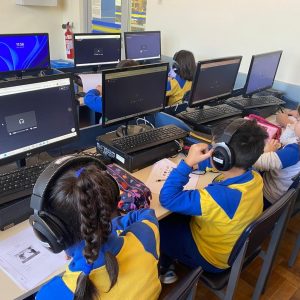
As part of the interdisciplinary project “80 Years Since World War II: Art in Times of War,” the ICT student team—Valentina Oyanadel, Catalina Oyanadel, and Rocío Oyarzúa—conducted a series of interviews with the teachers leading the initiative. These conversations were designed, recorded, and transcribed by the students as part of the project’s audiovisual documentation, combining bilingual work, critical thinking, and responsible use of Artificial Intelligence.
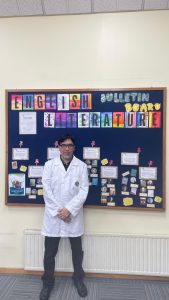
One of the interviews featured Mr. Luis González, teacher of the Aesthetics Elective, who reflected on the interdisciplinary nature of the project and the learning processes that emerged throughout the experience. He described his participation as “very interesting,” emphasizing the value of working across different areas of knowledge and the importance of collaboration when designing activities that connect philosophy, art, English, and historical reflection.
When discussing the challenges of the project, Mr. González highlighted the need to reach agreements across disciplines, both in terms of content and timing. He noted that these negotiations required communication skills, flexibility, and the ability to find common ground, not only among teachers but also among students participating in the project.
Reflecting on student growth, he explained that learners in the Aesthetics Elective already possess strong analytical and reflective abilities. What became truly meaningful, he noted, was the requirement to work through these ideas in English, adopting a new linguistic and cultural lens that enriched their understanding and expanded their cultural background.
Regarding the ethical dimensions of art, Mr. González pointed out that the project encouraged students to examine a fundamental philosophical question: Should art take a political stance in moments of crisis such as totalitarianism, or should it remain neutral? This debate allowed students to connect aesthetics with broader human and civic questions.
He also addressed the role of Artificial Intelligence, explaining that AI supported students by accelerating research, helping them move through stages efficiently, and offering structured information when properly guided. He emphasized that AI has become an integral tool in a pragmatic, fast-paced world, useful when used critically and responsibly.
As a final product, students in his course produced a critical essay in English, where they explored themes related to art, memory, ethics, and historical interpretation. According to Mr. González, the essay format allowed students to develop both their critical thinking and their linguistic skills, demonstrating academic growth through a humanities-focused task.
This interview is part of a broader documentation effort within the project, showcasing the voices, perspectives, and reflections that shape “80 Years Since World War II: Art in Times of War.” Additional interview articles will be published soon as the ICT team continues sharing insights gathered throughout this learning journey.