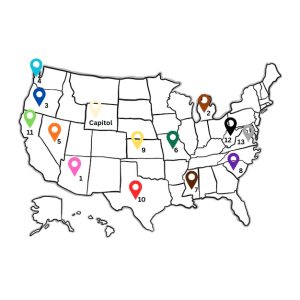
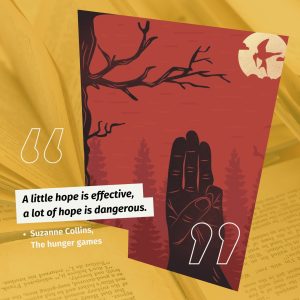
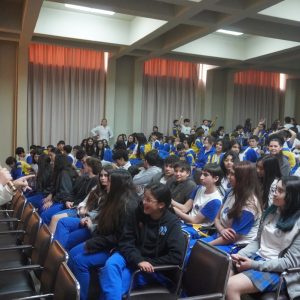
As part of the activities developed in our Book Club, students from 3rd grade Senior Area worked on a cartographic map inspired by The Hunger Games, using the present-day map of the United States of America as a base to imagine the dystopian nation of Panem.
This activity was carried out by Kim Mutters and Alba Röhrig, who are currently reading The Hunger Games as part of their Book Club process. During the session, students focused on the idea of world-building, analysing how Suzanne Collins presents Panem as a future, dystopian and post-apocalyptic society built on the ruins of North America.
This clarification was an important part of the activity, as the story does not take place in a completely separate fantasy world, but in a possible future version of our own. Because of climate change, rising sea levels and catastrophic wars, the geography of North America has changed drastically in the saga. For this reason, students used the map of the United States as a starting point to organise and reinterpret the location of the Capitol and the districts.
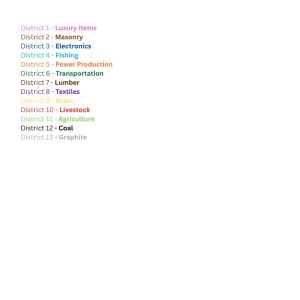
Through their cartographic work, students identified the different districts and their main industries, such as luxury items, masonry, electronics, fishing, power production, transportation, lumber, textiles, grain, livestock, agriculture, coal and graphite. They kept many of the details provided by the saga, but also made their own decisions about placement and distribution. In class, they explained why they located each district in a particular area, connecting geography, resources, production and the social structure of Panem.
The activity was connected to the discussion of Chapters 1 to 3, where students explored the structure of Panem, the role of the Capitol, and the significance of the Reaping. By designing and annotating the map, they were able to understand that setting is not only the place where a story happens, but also a key element that shows inequality, control, dependency and power.
As part of the reflection, students also imagined what life might be like in one of the districts, considering the daily routines, limitations and challenges faced by the people who live there. This helped them move beyond the plot and think more deeply about the dystopian society created by Suzanne Collins, as well as the ideas of survival, oppression and social inequality present in the novel.
We invite our school community to see the map attached to this publication and appreciate the creative and thoughtful work developed by our Book Club students.
Through activities like this, the Book Club continues to create meaningful spaces where students can read, discuss, design and use English as a tool to explore literature, imagination and critical reflection.