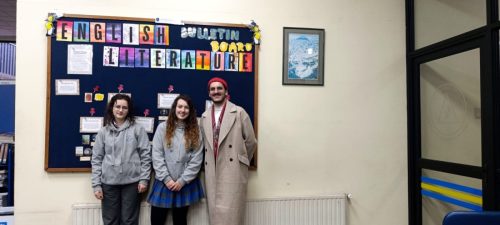
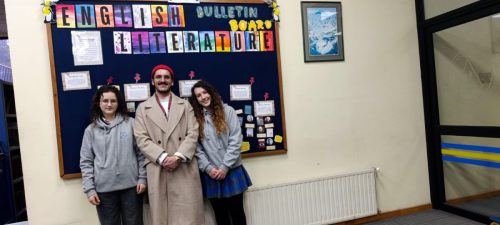
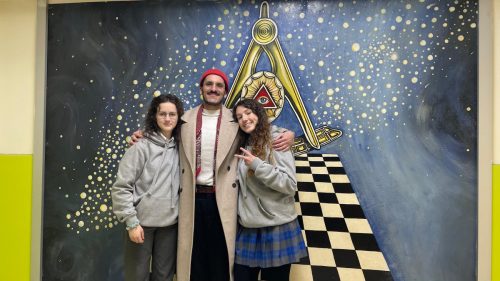
As part of the Book Club experience at Colegio Concepción, students Kim Müters and Alba Röhrig completed their reading journey of The Hunger Games by Suzanne Collins through a final written assignment focused on one essential question: Why is The Hunger Games considered a dystopian novel?
This activity marked a very special moment for the Book Club, as it was the final assignment Kim and Alba completed before returning to Germany after their exchange experience at our school. During their time at Colegio Concepción, the Book Club became a meaningful space where they could continue developing their English language skills, participate in literary discussion, and share their ideas through reading, analysis, and written expression. At the same time, their exchange experience also allowed them to approach a new language and culture through Spanish and everyday school life in Chile.
Throughout the term, The Hunger Games offered a rich opportunity to explore literature beyond the plot. The novel opened conversations about power, inequality, survival, media, government control, social division, and the way fiction can reflect concerns that are also present in the real world. Through reading and discussion, the students analysed how Suzanne Collins creates the fictional nation of Panem as a future society marked by fear, surveillance, poverty, privilege, and political oppression.
For their final task, Kim and Alba wrote analytical essays explaining why the novel belongs to the dystopian genre. Their work showed a careful reading of the text and a strong ability to support ideas with examples from the book. Both essays explored how Panem is built after the destruction of North America and how this future setting becomes one of the first elements that connects the novel with dystopian literature.
Another important aspect developed in their essays was the use of technology as a tool of control. From the Capitol’s luxury and advanced systems to the hovercrafts, cameras, muttations, and mechanisms used inside the arena, the students reflected on how technology in the novel does not necessarily represent progress for everyone. Instead, it becomes a way to increase inequality, intimidate the districts, and maintain the Capitol’s power.
The essays also highlighted one of the strongest dystopian elements in the novel: the control exercised by the Capitol over the districts. Through fear, punishment, surveillance, propaganda, hunger, and the annual Hunger Games, the government limits freedom and turns violence into public entertainment. In this sense, the students recognised that the novel is not only an exciting young-adult story, but also a critical reflection on political power, social injustice, and the manipulation of information.
This final assignment allowed Kim and Alba to bring together literary interpretation, academic writing, and critical thinking in English. It also represented the closing of a reading process that included discussion, contextual analysis, creative activities, and reflection on the way dystopian fiction can help readers question the world around them.
For the Book Club, this experience was especially meaningful. It showed how literature can become a meeting point between students from different countries, languages, and cultures. Through The Hunger Games, Kim and Alba were able to use English as a space for expression and analysis while also taking part in a school community where they were learning Spanish and experiencing life in Chile.
We warmly congratulate Kim and Alba for their commitment, depth of analysis, and enthusiasm throughout this Book Club reading journey. Their final essays became not only the closing activity of the term, but also a beautiful way to celebrate their participation, their growth, and the literary conversations shared during their time at Colegio Concepción.
We invite our school community to explore the students’ essays and appreciate the way literature, language learning, and international exchange can come together through meaningful reading experiences.
The Hunger Games Written by Kim Müters
The Hunger Games Written by Alba Röhrig