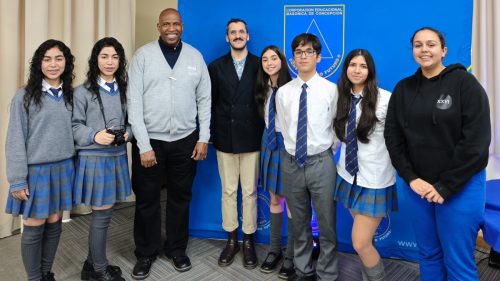
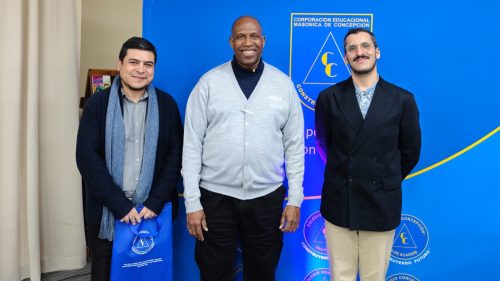
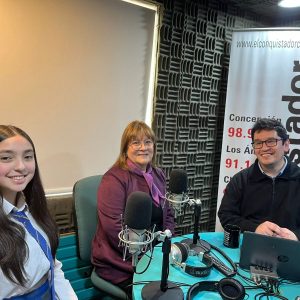
As a continuation of the masterclass on talent, motivation, and student development, a special interview was held with Dr Frank C. Worrell, from the University of California, Berkeley, and Dr Cristián Oyanadel Veliz, from the University of Concepción. This conversation allowed the ideas shared during the main presentation to be extended into a more personal and reflective space, bringing both academic perspectives closer to the school community.
The interview focused on the professional work, research experience, and educational reflections of both guests. Through the conversation, topics such as motivation, talent development, emotional regulation, prevention, school wellbeing, and the role of English as a real tool for academic communication were explored.
During the interview, Dr Worrell introduced himself as a professor of psychology at the University of California, Berkeley. He explained that his work includes three main areas: conducting research, teaching and advising students, and contributing to professional academic service through journals, committees, and academic associations. His answer helped show that academic life is not only connected to teaching, but also to investigation, collaboration, and the constant construction of knowledge.
One of the important points addressed was Dr Worrell’s visit to Chile and his connection with Dr Oyanadel’s research project. He explained that Dr Oyanadel’s grant allowed him to visit the University of California, Berkeley, and later made it possible for Dr Worrell to come to Chile and participate in academic activities at the University of Concepción. During his visit, he shared reflections connected to prevention, education, and student development.
When asked about advice for students and schools, Dr Worrell shared a simple but powerful message: students should always try their best and not give up when things become difficult. He reminded them that effort may not always show immediate results, but it can become meaningful in the long term. His words invited students to keep trying, trust the process, and understand perseverance as an important part of learning.
The interview also included the perspective of Dr Cristián Oyanadel Veliz, psychologist, professor at the Department of Psychology of the University of Concepción, clinical psychologist, and Director of the Master’s Programme in Clinical Psychology. He explained that his research project is an experimental study focused on psychological intervention in elementary and secondary levels, working with concepts related to time perspective: how students think about the past, the present, and the future.
Dr Oyanadel shared that the project included practices and exercises connected to meditation and emotional regulation. It was applied in two regions of Chile, involving ten schools and almost 800 students. According to his explanation, the results showed the importance of time perspective and meditation for emotional regulation and academic outcomes, especially in school contexts where students face different moments of pressure and change.
Reflecting on Dr Worrell’s visit, Dr Oyanadel highlighted two important impacts. First, the content of the talk allowed students to think about talent development, motivation, dreams, and personal goals. Second, the fact that the masterclass was conducted in English created an immersive language experience, giving students the chance to listen to an international academic speaker and participate through questions in a real communicative context.
Dr Oyanadel also shared recommendations for schools based on his research. He explained that interventions related to time perspective and emotional regulation can help students manage stress, anxiety, and the pressure that can increase throughout the school year. He also emphasised the importance of applying these strategies in an integral way, including students, families, teachers, and school staff, especially during critical stages such as the transition from elementary to secondary education or the final years before university.
This interview made it possible to organise and share ideas connected to motivation, emotional wellbeing, academic growth, English, and the role of schools in supporting students’ development. It also showed how ICT can be used as a meaningful tool for communication, allowing an academic conversation to be recorded, transcribed, organised, and transformed into an article for the school community.
Experiences like this remind us that learning can continue after a masterclass, through dialogue, questions, and the opportunity to listen carefully to the voices of people who are contributing to education, psychology, and student wellbeing. This conversation with Dr Worrell and Dr Oyanadel helped preserve valuable reflections that connect academic knowledge with the real experiences and challenges of school life.
Article and interview by the ICT Team
Edited and enhanced with AI support